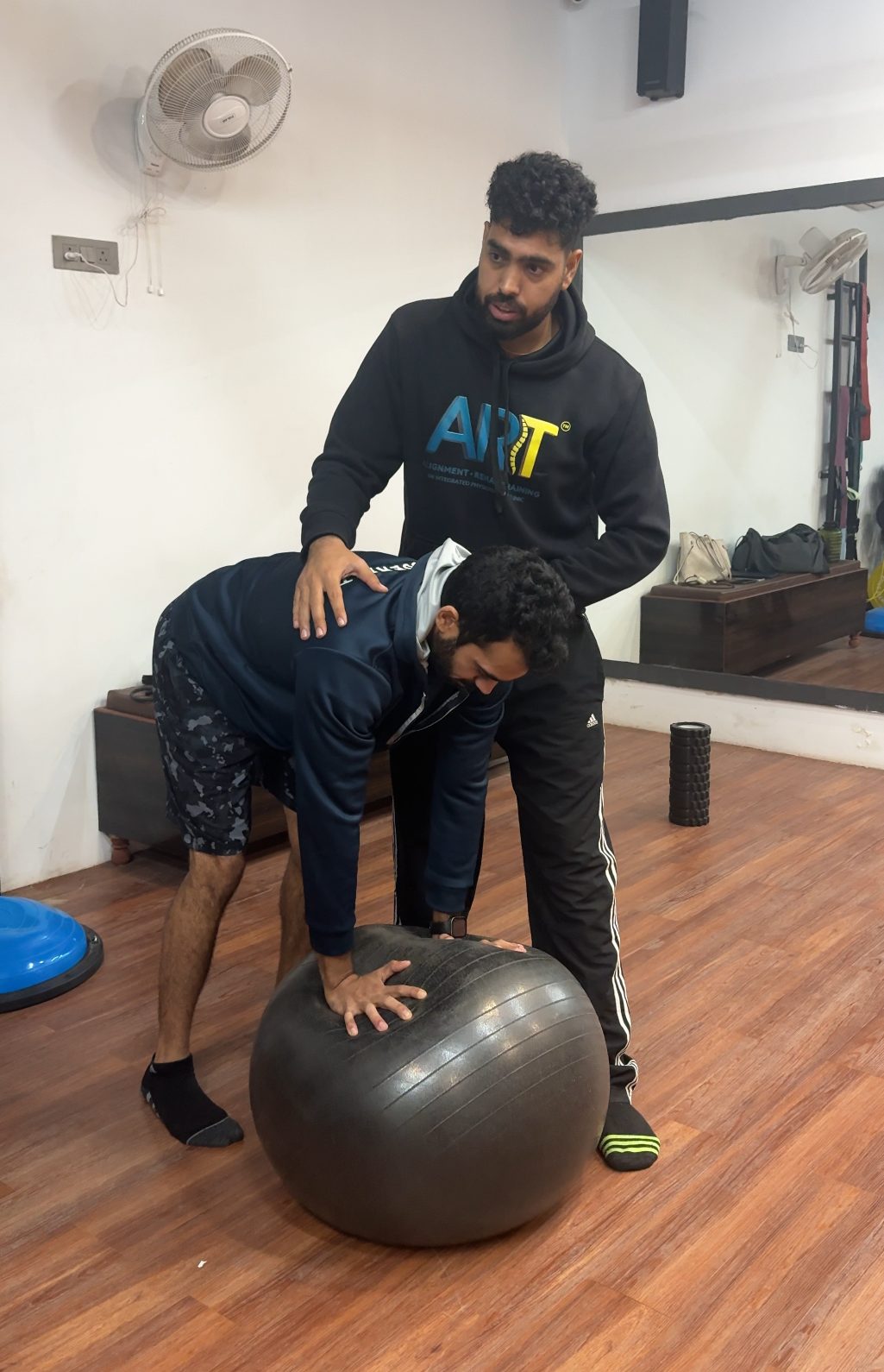
It starts innocently: a dull shoulder ache, maybe after a minor strain or for no reason at all. Then reaching overhead gets harder, fastening the seatbelt hurts, and sleep becomes a nightly negotiation with the pillow. Frozen shoulder is one of the most frustrating conditions we treat at our Sector 58 clinic, because it is slow, stubborn and widely misunderstood.
Frozen shoulder, or adhesive capsulitis, is an inflammation and thickening of the shoulder capsule, the tissue envelope around the joint. The capsule contracts like shrink-wrap and movement gradually disappears. It moves through three recognised stages, and each stage needs a different approach.
Stage 1: freezing (roughly 2 to 9 months)
This is the painful stage: the ache grows, motion shrinks week by week, and night pain is the signature complaint. Lying on the affected side becomes impossible and the pain can wake you repeatedly. Many patients are convinced something is torn, but the joint is simply inflamed and guarded.
What helps now: pain management and gentle, pain-free movement: heat, activity modification and keeping the shoulder mobile within comfortable limits. A corticosteroid injection, discussed with your doctor, can meaningfully reduce pain and make physiotherapy possible at this stage. Aggressive stretching, covered below, does not help.
Stage 2: frozen (roughly 4 to 12 months)
Pain often eases now, which feels like progress, but stiffness dominates: raising the arm, rotating it outward or reaching behind the back become severely limited, and shirts, hair, seatbelts and overhead cupboards all become challenges.
What helps now: graded joint mobilisation by your physiotherapist, sustained gentle stretching within tolerable limits, and scapular control exercises. The goal is to gradually expand available range without provoking big flare-ups.
Stage 3: thawing (months to over a year)
Slowly, movement begins to return. Pain is usually minimal and range improves month by month. This is the longest and most encouraging stage, but also where many patients stop treatment too early.
What helps now: progressive strengthening. As the capsule loosens, the rotator cuff and scapular stabilisers must be rebuilt to reclaim full, confident function. Patients who finish with structured strengthening get back to overhead sport, lifting and pain-free sleep; those who just wait for the thaw often end up with a shoulder that moves but never fully trusts itself.
Why aggressive stretching backfires early
This is the most common mistake. In the freezing stage the capsule is actively inflamed, and forcing the arm into painful stretches or hanging through sharp pain does not fix the problem. It provokes more inflammation and guarding, and often more pain the next day, leaving the shoulder stiffer, not looser.
The rule is simple: respect irritability. Movement should stay within limits that do not cause a significant pain flare lasting into the next day. As the condition moves into the frozen stage and irritability drops, the dosage of mobilisation can safely rise. Intensity follows the stage, never the calendar or the patient's frustration.
A frozen shoulder is a marathon, not a sprint. The patients who recover best are the ones who respect the stage they are in.
The role of graded mobilisation and strengthening
Our treatment matches the stage. In freezing, we calm: gentle manual therapy and advice on sleep and daily activity. In frozen, we mobilise: graded joint glides plus sustained self-stretches and active-assisted home exercises. In thawing, we strengthen: rotator cuff and scapular work with bands and light weights, progressing back to your normal activities.
Through all three stages we also watch the neck, mid-back and shoulder blade mechanics. Months of guarding create secondary stiffness above and below the joint, and addressing those keeps recovery smooth.
What you can do at home
- Pendulum swings. Lean forward, let the arm hang, and let it swing in small circles. Gentle, pain-free and excellent for keeping the joint nourished.
- Use heat before movement. A warm pack for ten minutes eases muscle guarding and makes gentle exercises easier.
- Protect your sleep. A pillow tucked under the affected arm, or sleeping semi-reclined, often reduces night pain dramatically.
- Stay within tolerable limits. Daily gentle movement beats occasional heroic stretching sessions every time.
- Manage expectations. This condition runs 12 to 24 months in most people. Knowing the timeline prevents the panic that leads to harmful over-stretching.
Is frozen shoulder the same as a rotator cuff tear?
No, they are different problems that can feel similar. Frozen shoulder is a stiff, contracted capsule with a global loss of motion; a rotator cuff tear is damaged tendon tissue, usually with weakness in specific directions. We distinguish them with movement and strength testing, because the treatments are quite different.
Do steroid injections help frozen shoulder?
A corticosteroid injection can reduce pain effectively, particularly in the freezing stage, and is sometimes what makes physiotherapy tolerable. It does not loosen the capsule by itself, so it works best combined with a proper rehab programme. Your doctor can advise whether it is appropriate for your stage.
Will my shoulder ever move normally again?
In most cases, yes. The majority regain near-full movement over 12 to 24 months with consistent, stage-appropriate rehabilitation. Starting treatment early and finishing with strengthening, rather than stopping when pain eases, gives the best outcomes.
If your shoulder pain is worsening month by month and night pain is part of the picture, it deserves an in-person assessment. Come in and we will identify which stage you are in and build a plan that matches it.