Pain rarely lives where you feel it. A stiff thoracic spine can masquerade as shoulder pain; a locked ankle can overload a knee. Manual therapy is the hands-on skill of finding these hidden drivers — joint mobilisations, spinal manipulation, soft-tissue release and neural glides, chosen by testing rather than habit. At our Sector 58 clinic, every manual therapy session starts with assessment: we provoke, ease and re-test, so you feel the change before you leave the room. It is not a generic massage or a cracking ritual. It is precise, measured and combined with exercise, because hands alone rarely hold a result without strength behind it. Patients come to us for back pain, neck stiffness, headaches, joint restrictions and post-injury tightness that stretching never resolved. If your pain moves, shifts or changes with position, there is usually a mechanical story — and hands trained to read it. This is the Rehab pillar of the ART method: calm the tissue, restore the movement, then train it to last.
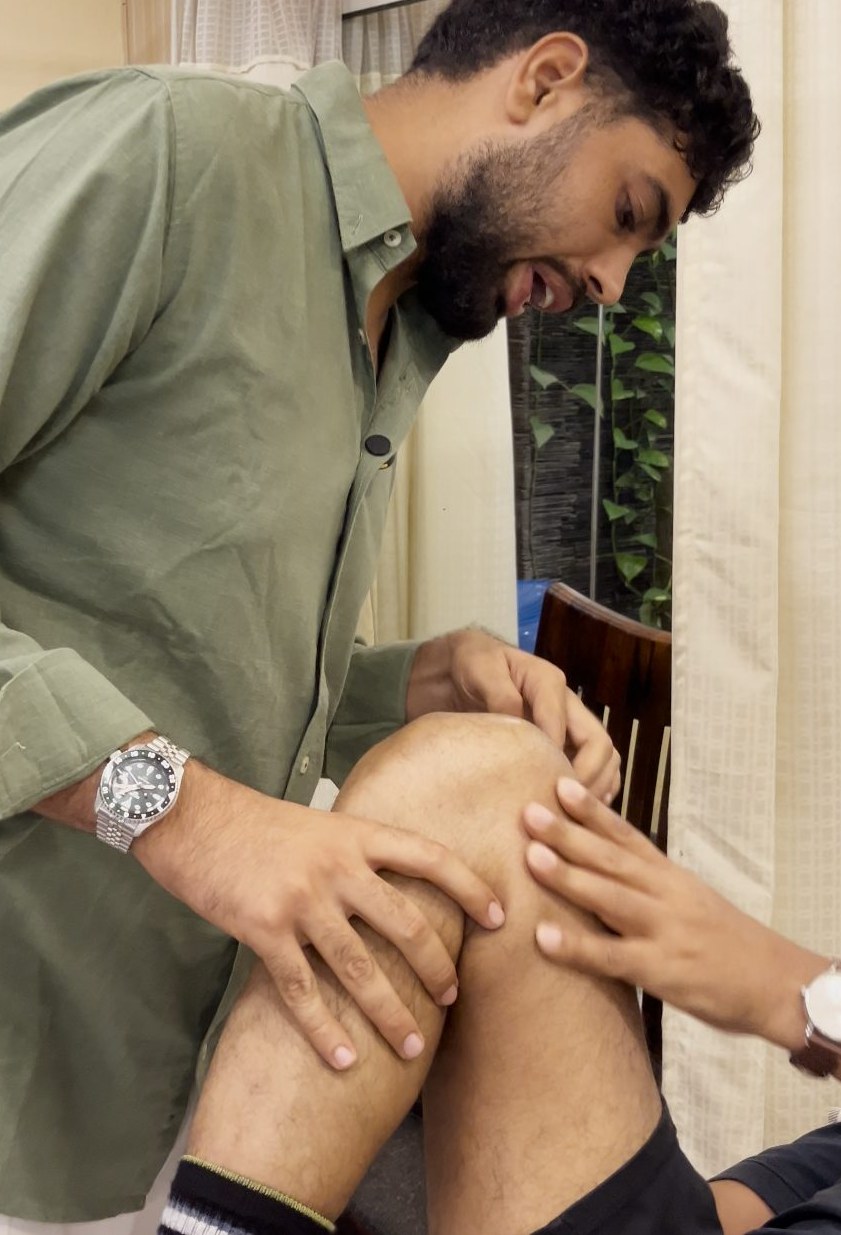
Manual therapy shines where movement is restricted and pain shifts with position. We assess first, treat only what testing confirms, and re-test before you leave.
Every plan follows the ART method — Alignment to find the cause, Rehab to treat it, Training to make it last.
We test joint-by-joint to find the segments and tissues driving your symptoms — treatment is only used where it is genuinely indicated.
Targeted joint mobilisations, spinal manipulation where appropriate, soft-tissue release and neural glides — precise, never forced.
Gentle activation and mobility work immediately after hands-on treatment, so the freed joint learns to move well.
Targeted strengthening of the weak neighbours that forced the problem — so the stiffness does not return.
Manual therapy suits pain with a mechanical pattern — pain that moves, eases with a change of position, or followed an injury.
Hands are only half the plan. Every manual therapy block is paired with exercise, because mobility gained without strength behind it rarely lasts. That is the ART method: Alignment to find it, Rehab to fix it, Training to keep it.
Only when it is indicated. Spinal manipulation is one tool among many — most of our work is gentle mobilisation, soft-tissue release and neural glides. Nothing is forced, and every technique is chosen by testing, not routine.
It can be briefly uncomfortable on irritable tissue, but you should feel improvement within the session. We re-test after treating, so you know it worked before you leave.
Massage relaxes muscle generally. Manual therapy targets the specific joints, nerves and tissues driving your symptoms — and it is always paired with exercise to make the change last.
Many mechanical problems shift in 3–6 sessions when paired with the right exercises. Chronic or multi-area issues are managed as part of a broader rehab plan.
Book an assessment at our Sector 58 or Sushant Lok clinic — open daily 7:00 AM – 9:00 PM. Your first session includes a full movement evaluation and a clear treatment plan. Rated 5.0 across 190+ Google reviews.